How to become a cloud engineer
By the RoleMath Editorial Team · Last updated 2026-06-14. Every figure traces to a cited official source; we sell none of the options discussed. Draft pending human review.
"How to become a cloud engineer" is a common career change into tech — and one where the honest path matters, because most sources answer it while selling you something. We sell nothing. A cloud engineer builds, deploys, and maintains applications and infrastructure on cloud platforms like AWS, Azure, and Google Cloud — automating systems and keeping them reliable and secure. Here is the cited, step-by-step version, with no guarantees attached.
Key takeaways
- The core skills to build are one cloud platform (AWS, Azure, or Google Cloud), Linux and networking fundamentals, and infrastructure-as-code and automation basics — proven with a portfolio, not just a certificate.
- Start with a beginner-appropriate certification, not an experience-gated one — check eligibility first.
- Follow a sequenced learning roadmap and prove your skills with hands-on projects; credentials alone don't land the job.
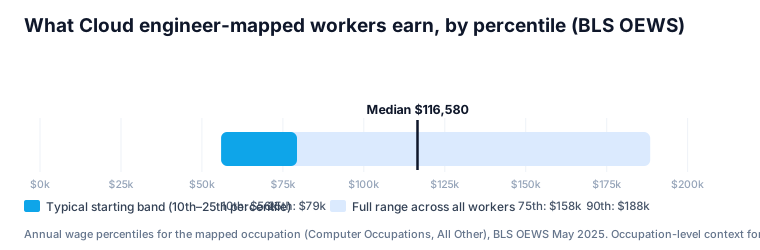
- The mapped occupation's BLS median is $116,580, but the realistic early-career band (10th–25th percentile) is $55,940–$79,370, with a +8.2% projected change — occupation-level context, not a personal salary or hiring guarantee.
- Study free and use funding to keep your out-of-pocket cost low; no route guarantees a job.
What a cloud engineer does — the cited day-to-day
A cloud engineer builds, deploys, and maintains applications and infrastructure on cloud platforms like AWS, Azure, and Google Cloud — automating systems and keeping them reliable and secure. Day to day, ONET — the U.S. Department of Labor's occupational database — lists core tasks for the mapped occupation such as: communicate with staff or clients to understand specific system requirements; investigate system component suitability for specified purposes, and make recommendations regarding component use. ONET lists technologies for this occupation such as AWS, Microsoft Azure, Docker, Kubernetes. By O*NET's interest data the work tends to fit structured, detail-oriented work and analytical problem-solving — the occupation's typical profile, not a verdict on whether it fits you. Heads-up: BLS groups this role with a network security engineer in one occupation, so the cited pay and outlook figures here are shared across those guides — the day-to-day differs, and a cloud engineer focuses on building and deploying cloud infrastructure.
The honest entry path, step by step
Rather than collecting credentials, follow this sequence:
1. Build the foundational skills. For a cloud engineer, that means one cloud platform (AWS, Azure, or Google Cloud), Linux and networking fundamentals, and infrastructure-as-code and automation basics.
2. Earn one beginner-appropriate certification (see the next section) — not a stack of them.
3. Prove your skills with a portfolio. For example: a small app deployed to a cloud platform with infrastructure-as-code, documented in a public repo.
4. Apply, and keep learning on the job. Entry roles expect you to grow into them.
Cloud is well-paid and growing, but it usually isn't a first-day role: most people reach it after a support or sysadmin foundation, then add a cloud certification and hands-on labs.
Do you need a degree for this role?
By the cited BLS data, the typical entry-level education for the mapped occupation is a bachelor's degree, and it typically lists no prior work experience. "Typical" is BLS's judgment of the common entry route, not a hard requirement or a legal gate. Where a degree is the typical route, competing without one is harder — but many employers, especially in IT, cloud, and security, will consider a relevant certification plus a portfolio instead. That's employer-dependent, not guaranteed.
Certifications: where to start (and what to avoid)
A foundational cloud certification (such as AWS Cloud Practitioner or Azure Fundamentals) is open to beginners and inexpensive — a sensible, honest first cloud step. Confirm eligibility before you pay. Whatever you target, confirm the credential is genuinely open to a beginner before you pay.
What it costs and how long it takes
The honest cost is the exam plus any optional training and renewal — see the full cited breakdown rather than an exam-only figure, and study with free official resources to keep the rest near $0. Timelines vary with your background and study intensity; no honest source can promise a fixed timeline or guarantee a job.
What it really pays — the cited percentiles
This role maps to a BLS occupation, the Computer Occupations, All Other — a broad BLS catch-all category, so treat the figures as a rough proxy. As a career changer you'll most likely start near the lower end of the range: the cited 10th–25th percentile runs $55,940–$79,370 (BLS OEWS May 2025) — read that as a realistic early-career planning range, not a rule, since these are all-worker percentiles. The occupation's overall median is $116,580, but that's the midpoint across all workers including experienced ones, so treat it as where the broader occupation tops out with experience, not a starting wage. The chart shows the full spread. Every figure is occupation-level context — not what you personally will earn, not a certification outcome, and not a hiring guarantee.
Is the field growing? The cited outlook
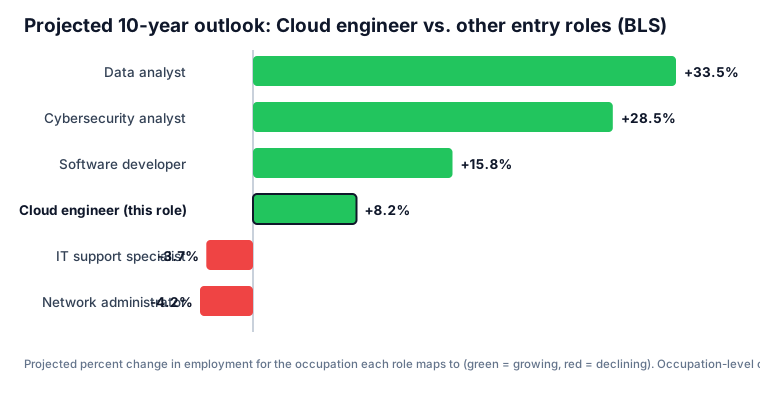
BLS projects a +8.2% change for the mapped occupation over 2024–2034 (~31.3k annual openings). A projection is occupation-level context for the broader occupation, not a personal guarantee.
How to do it without going broke
The unavoidable cost is the certification exam fee. Study with free official resources to avoid paying for training, and use funding — public workforce programs (WIOA), veterans' benefits, or employer tuition assistance — to cover the exam itself, which can bring your out-of-pocket cost close to zero. No amount of spending guarantees a job.
Frequently asked questions
How long does it take to become a cloud engineer?
It varies with your background and study pace — often several months of focused study for a foundational certification plus hands-on practice. No honest source can promise a fixed timeline or guarantee a job.
What certifications do you need to become a cloud engineer?
A foundational cloud certification (such as AWS Cloud Practitioner or Azure Fundamentals) is open to beginners and inexpensive — a sensible, honest first cloud step. Confirm eligibility before you pay. See which certifications you can actually earn now, and the role's roadmap for the cited sequence.
Can you become a cloud engineer with no experience?
You can begin with no work experience — entry certifications are open to beginners — but you'll need demonstrable, hands-on skills and a portfolio. "Entry-level" still means you can do the work.
How much does a cloud engineer make?
The mapped BLS occupation has a national median wage of $116,580, but as a career changer you'll more likely start nearer the cited 10th–25th percentile band ($55,940–$79,370). These are occupation-level figures for the broader occupation, not your guaranteed salary — see the cited detail and compare across entry paths.
Is being a cloud engineer a good career?
BLS projects a +8.2% change for the mapped occupation, which is positive — but a projection is occupation-level context, not a personal guarantee, and no role is right for everyone.
Related, with the cited detail
Sources
Figures in this article are cited to the sources named in the Citation Ledger below and on each linked cited page. Charts are drawn from those cited BLS figures, with the source noted in each caption. This page stays draft_noindex pending human citation review.
Citation Ledger
| ID | Supports | Evidence | Source |
|---|
| CIT-01 | Wage median and 10th–90th percentiles | BLS OEWS, May 2025 | U.S. Bureau of Labor Statistics (OEWS) |
| CIT-02 | Projected employment change and annual openings | BLS Employment Projections, 2024–2034 | U.S. Bureau of Labor Statistics (Employment Projections) |
| CIT-03 | Typical entry education and related work experience | BLS Employment Projections, 2024–2034 | U.S. Bureau of Labor Statistics (Employment Projections) |
| CIT-04 | Day-to-day tasks, technologies, and interest profile | O*NET database | U.S. Department of Labor (O*NET) |