How to become a software developer
By the RoleMath Editorial Team · Last updated 2026-06-14. Every figure traces to a cited official source; we sell none of the options discussed. Draft pending human review.
"How to become a software developer" is a common career change into tech — and one where the honest path matters, because most sources answer it while selling you something. We sell nothing. A software developer designs, writes, tests, and maintains the programs and applications that run on computers, phones, and the web — translating requirements into working code. Here is the cited, step-by-step version, with no guarantees attached.
Key takeaways
- The core skills to build are a programming language (Python, JavaScript, or Java), version control with Git, data structures and algorithms, and the habit of shipping small, real projects — proven with a portfolio of working projects.
- Treat credentials as optional support; lead with projects an interviewer can inspect.
- Follow a sequenced learning roadmap and prove your skills with hands-on projects; credentials alone don't land the job.
- The mapped occupation's BLS median is $135,980, but the realistic early-career band (10th–25th percentile) is $82,460–$105,210, with a +15.8% projected change — occupation-level context, not a personal salary or hiring guarantee.
- Study free and use funding to keep your out-of-pocket cost low; no route guarantees a job.
What a software developer does — the cited day-to-day
A software developer designs, writes, tests, and maintains the programs and applications that run on computers, phones, and the web — translating requirements into working code. Day to day, ONET — the U.S. Department of Labor's occupational database — lists core tasks for the mapped occupation such as: analyze user needs and software requirements to determine feasibility of design within time and cost constraints; develop or direct software system testing or validation procedures, programming, or documentation. ONET lists technologies for this occupation such as Git, JavaScript, Docker, Linux. By O*NET's interest data the work tends to fit analytical problem-solving and structured, detail-oriented work — the occupation's typical profile, not a verdict on whether it fits you.
The honest entry path, step by step
Rather than collecting credentials, follow this sequence:
1. Build the foundational skills. For a software developer, that means a programming language (Python, JavaScript, or Java), version control with Git, data structures and algorithms, and the habit of shipping small, real projects.
2. Use credentials selectively. Only pay for a course or credential if it helps you fill a specific gap; the portfolio is the main proof.
3. Prove your skills with a portfolio. For example: two or three working apps on GitHub — say a web app, an API, and a command-line tool — that you can walk an interviewer through.
4. Apply, and keep learning on the job. Entry roles expect you to grow into them.
Software development is skills-first: a portfolio of working projects matters more than any single credential, and "entry-level" still means you can actually build things.
Do you need a degree for this role?
By the cited BLS data, the typical entry-level education for the mapped occupation is a bachelor's degree, and it typically lists no prior work experience. "Typical" is BLS's judgment of the common entry route, not a hard requirement or a legal gate. Where a degree is the typical route, competing without one is harder — but many employers, especially in IT, cloud, and security, will consider a relevant certification plus a portfolio instead. That's employer-dependent, not guaranteed.
Certifications: where to start (and what to avoid)
This is one of the few tech paths where certifications matter less than a demonstrable portfolio. Spend your time and money building real software, not collecting certificates. If a course or credential helps you learn a missing skill, use it as practice support, not as the proof by itself.
What it costs and how long it takes
The main cost is time: building projects, getting feedback, and practicing interviews. If you choose a course or credential, check the cited cost first, use free official resources where possible, and do not treat paid training as a shortcut to a job.
What it really pays — the cited percentiles
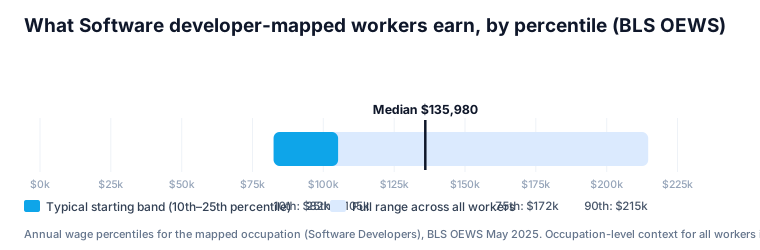
This role maps to a BLS occupation, the Software Developers. As a career changer you'll most likely start near the lower end of the range: the cited 10th–25th percentile runs $82,460–$105,210 (BLS OEWS May 2025) — read that as a realistic early-career planning range, not a rule, since these are all-worker percentiles. The occupation's overall median is $135,980, but that's the midpoint across all workers including experienced ones, so treat it as where the broader occupation tops out with experience, not a starting wage. The chart shows the full spread. Every figure is occupation-level context — not what you personally will earn, not a certification outcome, and not a hiring guarantee.
Is the field growing? The cited outlook
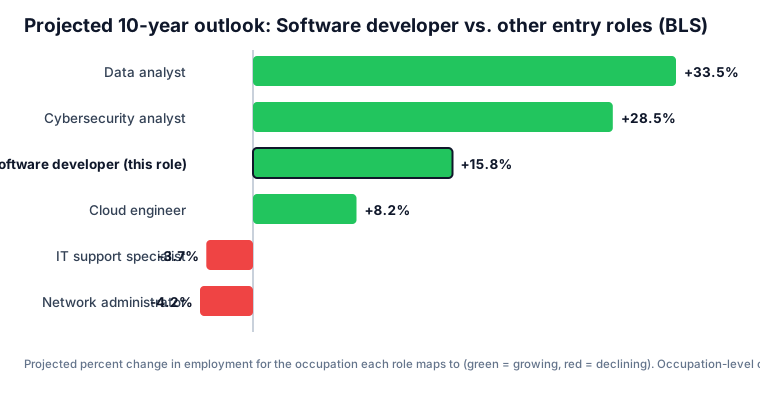
BLS projects a +15.8% change for the mapped occupation over 2024–2034 (~115.2k annual openings). A projection is occupation-level context for the broader occupation, not a personal guarantee.
How to do it without going broke
Keep the paid part optional. Use free official docs, public datasets, open-source tools, and portfolio projects before buying a course or credential. If you do pay, use funding only for a clear skill gap; no amount of spending guarantees a job.
Frequently asked questions
How long does it take to become a software developer?
It varies with your background and study pace — often several months of focused project work, fundamentals practice, and feedback. No honest source can promise a fixed timeline or guarantee a job.
What certifications do you need to become a software developer?
This is one of the few tech paths where certifications matter less than a demonstrable portfolio. Spend your time and money building real software, not collecting certificates. A portfolio of working projects is the stronger signal; use credentials only when they help structure your learning.
Can you become a software developer with no experience?
You can begin with no work experience, but you need demonstrable, hands-on skills and a portfolio. "Entry-level" still means you can do the work.
How much does a software developer make?
The mapped BLS occupation has a national median wage of $135,980, but as a career changer you'll more likely start nearer the cited 10th–25th percentile band ($82,460–$105,210). These are occupation-level figures for the broader occupation, not your guaranteed salary — see the cited detail and compare across entry paths.
Is being a software developer a good career?
BLS projects a +15.8% change for the mapped occupation, which is above-average — but a projection is occupation-level context, not a personal guarantee, and no role is right for everyone.
Related, with the cited detail
Sources
Figures in this article are cited to the sources named in the Citation Ledger below and on each linked cited page. Charts are drawn from those cited BLS figures, with the source noted in each caption. This page stays draft_noindex pending human citation review.
Citation Ledger
| ID | Supports | Evidence | Source |
|---|
| CIT-01 | Wage median and 10th–90th percentiles | BLS OEWS, May 2025 | U.S. Bureau of Labor Statistics (OEWS) |
| CIT-02 | Projected employment change and annual openings | BLS Employment Projections, 2024–2034 | U.S. Bureau of Labor Statistics (Employment Projections) |
| CIT-03 | Typical entry education and related work experience | BLS Employment Projections, 2024–2034 | U.S. Bureau of Labor Statistics (Employment Projections) |
| CIT-04 | Day-to-day tasks, technologies, and interest profile | O*NET database | U.S. Department of Labor (O*NET) |