How to read a bootcamp outcomes report
By the RoleMath Editorial Team · Last updated 2026-06-18. Every figure traces to a cited source; we sell none of the options discussed.
To read a bootcamp outcomes report honestly, treat it as a marketing document written by the school being measured: work out the exact denominator behind any "X% hired" figure, ask whether the report is third-party audited (e.g., CIRR-style) rather than self-published, and remember no reputable program can promise you a job. A bootcamp's outcomes report is the single most persuasive thing it shows you — and it's written by the organization that wants your tuition. That doesn't make it false, but it does make it a marketing document you should read like a skeptic. We don't sell you a bootcamp, and our recommendations are never influenced by who pays us, so here's the honest guide to what those hiring figures actually count, the methodology tricks to watch for, and the questions to ask before you trust any of it.
Key takeaways
- An outcomes report is a marketing document written by the school being measured — read it like a skeptic.
- The headline hiring figure lives or dies on its denominator; narrow definitions inflate it.
- A third-party-audited report (e.g., CIRR-style) is a stronger signal than a self-published infographic — but it's still that school's reported result, not a promise about you.
- Ask for the exact denominator, the as-of date, and whether it's audited; no reputable program can promise you a job.
Start by remembering who wrote it
An outcomes report is published by the school whose product is being measured. The good ones are honest; many quietly choose the definitions that make the numbers look best. Read every figure asking "what could make this look better than reality?" — because no school's self-published report can promise you the same result.
What a hiring figure actually counts (and quietly excludes)
The headline "X% hired" depends entirely on its denominator, and that's where figures get inflated. Watch for four moves: counting only "job-seeking graduates" while excluding everyone who didn't finish or didn't actively search; counting any job rather than an in-field tech job; counting part-time, contract, or internal placements as outcomes; and a 180-day window that quietly drops anyone who took longer. A 90% figure with a narrow denominator can describe far less than 90% of the people who enrolled.
| Report term | What it can quietly exclude |
|---|---|
| Job-seeking graduates (the denominator) | Everyone who didn't finish, or wasn't actively searching |
| Counted as employed | Out-of-field jobs counted the same as in-field tech roles |
| Counted as placed | Part-time, contract, or internal placements counted as wins |
| A 180-day window | Anyone who landed a role later, dropped from the count |
Work the denominator yourself: a 90% hired rate that counts only the 60% who were job-seeking is really 90% of 60% — about 54% of everyone who enrolled.
The standard that makes a figure trustworthy: independent reporting
The credible signal is a third-party-audited report following a shared standard such as the Council on Integrity in Results Reporting (CIRR), rather than a self-published infographic. Where a school publishes a CIRR-style audited report, that's a meaningfully stronger signal — but it is still that organization's reported result, dated and specific to its cohorts, not a promise about you. Treat any unaudited figure as marketing until proven otherwise.
The questions to ask before you trust any number
Ask the school directly, in writing: What is the exact denominator? Does "hired" mean an in-field role, and at what hours and pay? What is the as-of date and cohort size? Is the report third-party audited? What happens to graduates who aren't hired? Honest providers answer plainly; evasive answers are themselves an answer. And remember the rule that overrides every figure: no reputable program can promise you a job, and any so-called job pledge is usually a conditional tuition refund, not employment.
The honest baseline: even official data is mixed
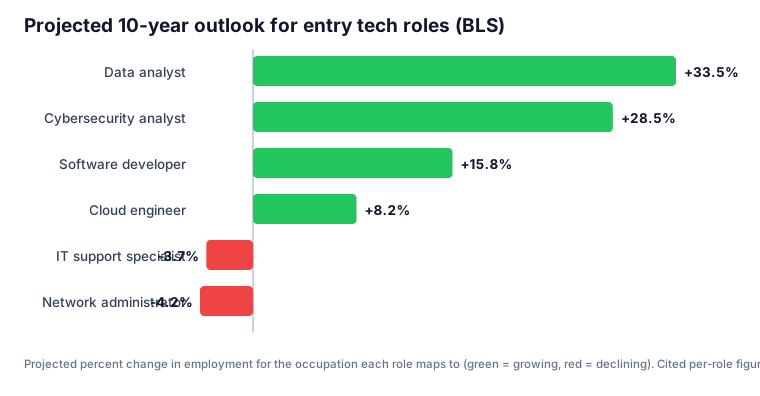
Compare a school's rosy infographic against what unbiased, cited data actually looks like. Official BLS projections for the occupations these roles map to show a genuine mix — some entry tech roles growing strongly, others projected to decline — with no cherry-picking and no promise attached. That's the honest shape of the labor market a real outcomes report should be read against.
Frequently asked questions
Are bootcamp outcomes reports accurate?
Some are; many use definitions that flatter the numbers. The accuracy depends on the denominator and whether the report is third-party audited — a self-published figure should be treated as marketing until you can verify what it counts.
What does a bootcamp "hired" rate actually mean?
It varies by school. It may exclude non-completers and non-job-seekers, may count any job rather than an in-field tech role, and may use a limited time window — so the same headline number can describe very different realities. Always ask for the exact denominator.
What is CIRR?
The Council on Integrity in Results Reporting is a shared standard for third-party-audited bootcamp outcomes reporting. A CIRR-style audited report is a stronger signal than a self-published infographic, though it's still that organization's reported result for specific cohorts, not a promise about your outcome.
Does a bootcamp "job pledge" mean I'll actually get a job?
No. A so-called job pledge is typically a conditional tuition refund with strict requirements, not a promise of employment. No reputable program can promise you a job, regardless of how the offer is worded.
How can I check a bootcamp's claims myself?
Ask in writing for the exact denominator, the definition of "hired," the as-of date, the cohort size, and whether the report is independently audited. Then weigh the answers against unbiased cited data, like the official outlook for the roles you're targeting.
Related, with the cited detail
- Is a coding bootcamp worth it?
- Compare every route into tech
- Certification vs degree vs bootcamp
- The fastest-growing entry roles
- Cheapest way to get into tech
- Start the RoleMath planner
Sources
Figures in this article are cited to the sources named in the Citation Ledger below and on each linked cited page. Charts are drawn from those cited BLS figures, with the source noted in each caption.
Citation Ledger
| ID | Supports | Evidence | Source |
|---|---|---|---|
| CIT-01 | Outcome reports are school-published marketing; the denominator (all graduates vs only job-seeking) and the definition of 'placed' swing the headline | RoleMath sourcing-pattern audit (web-verified entries), dated 2026-06-18 | RoleMath editorial pattern audit; verify current |
| CIT-02 | Audited outcome reporting (CIRR) and the regulatory record as the honest yardstick | Council on Integrity in Results Reporting (CIRR); CFPB outcome-marketing actions | cirr.org; consumerfinance.gov; verify current |
| CIT-03 | Occupation-level pay/outlook context (no placement figure published) | BLS OEWS / Employment Projections (occupation-level, cite-by-reference) | bls.gov |